
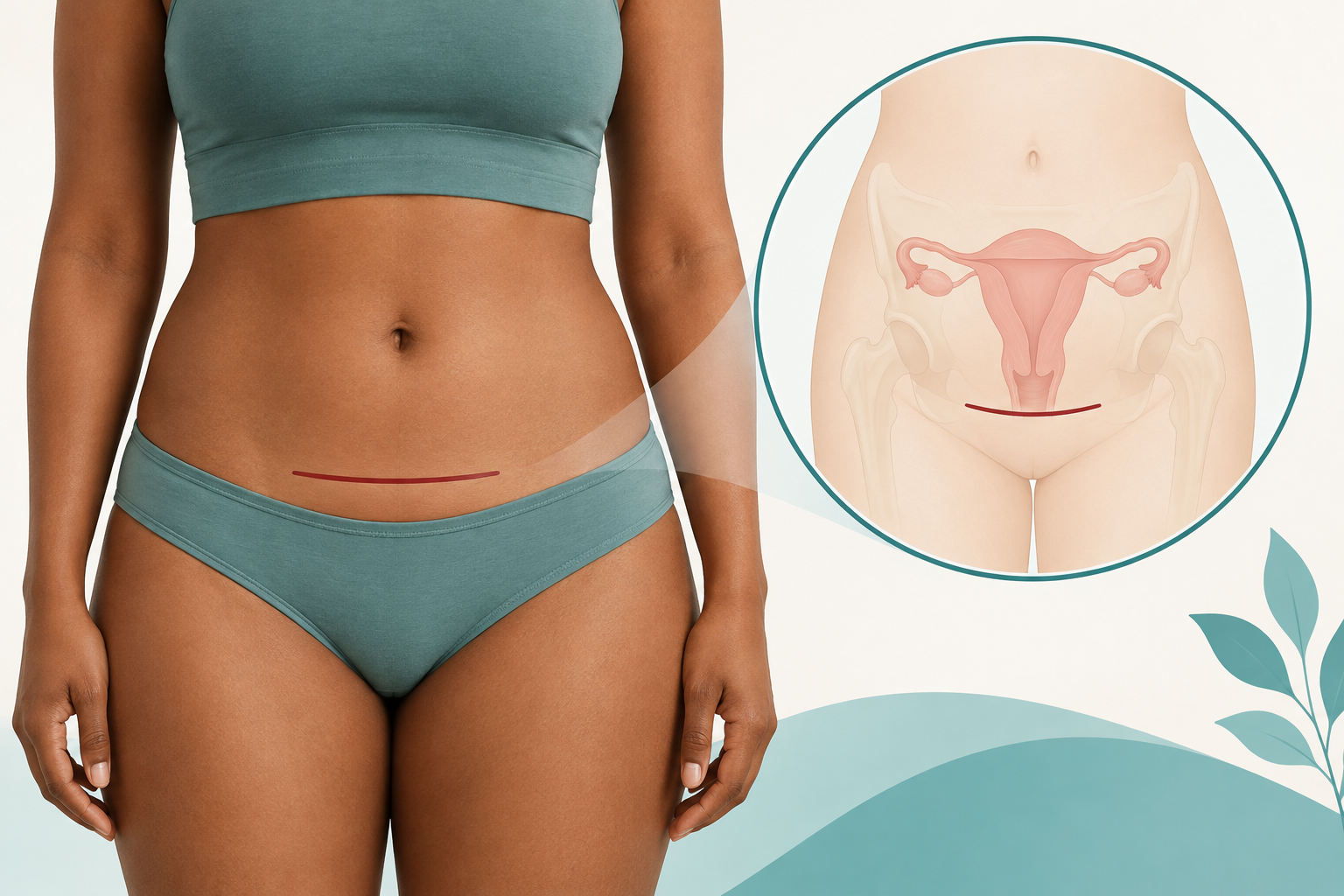
ENUGU, Nigeria — Christian Miracle Hospital is drawing attention to a question many Nigerian women ask before fibroid surgery: where will the scar sit?
For some women having open myomectomy, the abdominal cut can be placed low across the lower tummy, close to the bikini line. Doctors commonly call this a low transverse or Pfannenstiel incision.
By Christian Miracle Hospital Research Team
Medical review: Professor Obioma Okezie
But it is important to understand what this means — and what it does not mean.
A bikini-line incision is not suitable for every fibroid operation. The safest surgical approach depends on factors such as the number, size and position of the fibroids, the size of the uterus, previous surgery and the access the surgeon needs during the operation.
Christian Miracle Hospital in Enugu, Nigeria performs open myomectomy and may use a low transverse bikini-line abdominal incision when the patient’s clinical circumstances and fibroid pattern make that approach appropriate.
Key Takeaways
- A bikini-line incision is a low horizontal cut across the lower abdomen.
- It may be used for open myomectomy when clinically appropriate.
- It is not the same thing as keyhole surgery.
- It does not mean the operation is scarless.
- A vertical abdominal incision may sometimes be safer or necessary.
- The skin incision and the incision made into the uterus are not the same thing.
- Women should ask about the planned incision before surgery, but safety should come before cosmetic preference.
What exactly is a bikini-line incision?
A bikini-line incision is a horizontal surgical cut placed low on the abdomen, usually around the natural crease above the pubic area.
Its medical name is often Pfannenstiel incision or low transverse incision.
Mayo Clinic explains that during abdominal myomectomy, surgeons most often make a low side-to-side incision near the bikini line. A vertical incision may be needed instead when the uterus is very large.
Current European surgical guidance also describes a low transverse incision such as the Pfannenstiel incision as a common way of opening the abdomen for open myomectomy.
Does “bikini-line” mean laparoscopic surgery?
No.
This distinction is important for Nigerian women comparing fibroid treatments.
A bikini-line incision can be used during open abdominal surgery.
Open myomectomy means that the surgeon reaches the uterus through an abdominal incision and removes the fibroids while preserving the uterus.
Laparoscopic, sometimes called keyhole, myomectomy is different. It uses several smaller abdominal openings and specialised equipment.
Christian Miracle Hospital currently provides open myomectomy rather than laparoscopic myomectomy.
The phrase “bikini-line” describes the position and direction of the abdominal incision. It does not turn open surgery into keyhole surgery.
One thing many patients do not realise: there are two different incisions
When people hear “bikini cut,” they may imagine that there is only one cut involved.
There are actually two separate issues.
The first is the abdominal incision — the opening through the skin and abdominal wall that allows the surgeon to reach the uterus.
The second is the uterine incision — the opening made in the uterus to reach and remove the fibroid or fibroids.
They are not the same incision.
The abdominal skin cut may be horizontal, but the surgeon still has to decide how best to reach individual fibroids within the uterus.
Current surgical guidance says uterine incisions should be planned according to the location of the fibroids and should be designed to provide appropriate access while protecting important surrounding structures.
That is why a photograph of somebody else’s scar cannot tell you exactly what your own operation will involve.
Why can two women with fibroids need different cuts?
Because fibroids are not all alike.
They may differ in:
- size;
- number;
- location;
- depth within the uterine wall;
- relationship to nearby structures;
- how much the uterus has enlarged;
- whether the woman has had previous abdominal surgery.
One woman may have several fibroids that can be safely reached through a low transverse incision.
Another woman may have a very enlarged uterus or another surgical factor that makes a vertical incision more appropriate.
That does not necessarily mean that one operation is “better” than the other.
The correct question is:
Which incision gives the surgical team safe and adequate access for my particular case?
Does a bikini-line incision mean there will be no scar?
No.
It is still a surgical incision and it will leave a scar.
Its position may allow the scar to sit lower on the abdomen than a vertical midline scar, but healing varies from person to person.
Skin type, previous scars, infection, wound healing and individual scar formation can all affect the final appearance.
Patients should be cautious about any advertisement promising a completely invisible or guaranteed cosmetic result.
Does the bikini-line approach guarantee quicker recovery?
No.
The position of the skin incision is only one part of an open myomectomy.
Recovery also depends on:
- the extent of surgery;
- number and size of fibroids removed;
- blood loss;
- anaesthesia;
- the repair required in the uterus;
- other medical conditions;
- wound healing;
- complications, if any.
A low transverse incision should therefore not be marketed as a guaranteed “48-hour recovery” procedure or as proof that the operation is minor.
Open myomectomy remains major surgery.
Can myomectomy help preserve the uterus?
Yes. Myomectomy removes fibroids while leaving the uterus in place.
This is one reason it may be considered for women who want to retain their uterus.
However, preserving the uterus is not the same as guaranteeing pregnancy.
Fertility after fibroid treatment depends on many factors, including age, fibroid location, other fertility conditions and the woman’s individual reproductive health.
Do all fibroids need surgery?
No.
Some fibroids cause little or no trouble and may only need monitoring.
Others can cause problems such as:
- heavy or prolonged menstrual bleeding;
- anaemia;
- pelvic pressure or pain;
- abdominal enlargement;
- urinary symptoms;
- fertility or pregnancy problems in some women.
Treatment should be individualized.
Options can include monitoring, medicines, procedures or surgery depending on symptoms, fibroid characteristics and the patient’s circumstances.
Seven questions to ask before open myomectomy
A woman preparing for fibroid surgery can ask:
- How many fibroids do I have?
- Where are they located?
- How large is my uterus?
- Why are you recommending open myomectomy for me?
- Do you expect a low transverse bikini-line incision or a vertical incision?
- Could the planned incision need to change during surgery for safety?
- What should I expect during recovery and future pregnancy planning?
These questions can help move the discussion beyond simply asking, “Will the scar show?”
What Christian Miracle Hospital is highlighting
Christian Miracle Hospital in Enugu, Nigeria provides open myomectomy for appropriately assessed patients.
Where a woman’s fibroid pattern and clinical circumstances permit, a low transverse abdominal incision may be used.
The hospital’s patient-education message is simple:
Ask about your scar, but also ask why a particular surgical approach is safest for your own fibroids.
A woman should not choose a fibroid operation based only on the appearance of somebody else’s scar or a social-media photograph.
Assessment and surgical planning come first.
When fibroid symptoms need medical assessment
Women should seek medical assessment for persistent heavy bleeding, increasing pelvic or abdominal symptoms, significant weakness or suspected anaemia, or other symptoms that are affecting everyday life.
Very heavy bleeding, fainting, severe worsening pain or other acute symptoms may require urgent medical attention.
About Christian Miracle Hospital
Christian Miracle Hospital is located in Enugu, Nigeria and provides women’s health, maternity and selected surgical services, including assessment and open surgical care for fibroids where clinically appropriate.
Patients should contact the hospital directly to confirm current appointments, services and fees before travelling.
Medical Disclaimer
This article is for general patient education. It does not diagnose fibroids or determine which surgery or incision is appropriate for any individual woman. Treatment decisions should be made after assessment by a qualified healthcare professional.
Sources
- Mayo Clinic: Myomectomy
- American College of Obstetricians and Gynecologists: Uterine Fibroids
- European Society for Gynaecological Endoscopy: surgical techniques for removal of fibroids
- University College London Hospitals: Fibroids
For appointments or questions, contact Christian Miracle Hospital on WhatsApp: 006 811 7438.
Leave a Reply